Saw Palmetto
Serenoa repensBerry extract from a low-growing palm native to the southeastern United States.
Studied for: prostate function and hormone balance in older men.
Read the full pageSix botanicals and one mineral, each with its milligram figure printed on the label. Here is what every one is, where it comes from, what has actually been studied, and where the evidence runs out.
A great many supplements in this category use a proprietary blend: several ingredients grouped under one combined weight. You can see what is in the bottle but never how much of anything. The practice is legal and common, and its practical effect is that the product cannot be evaluated or compared by anyone outside the company.
Horsewood publishes a milligram figure for all seven ingredients and states the extract ratio for the two concentrated ones, so the dry-herb equivalent can be worked out. That is genuinely better than the norm and it deserves credit.
It also lets us tell you something most affiliate pages cannot. Total active content is around 118 mg per two-capsule serving. That is modest against the amounts used in much of the published research on these plants, which frequently runs into hundreds of milligrams. Transparency cuts both ways, and we would rather you heard that from us.
We have tried to separate three things that supplement marketing usually blends into one. Traditional use means a plant has a documented history in a herbal system — a good reason to investigate it, not proof of anything. Research interest means studies exist, which says nothing about their size or quality. Established evidence means findings have held up across reasonable trials, and it applies to less of this formula than any seller would like.
Where the evidence is thin we say so. Wild yam and sarsaparilla are the clearest examples and both are marked plainly on their own pages.
Ordered as they appear on the supplement facts panel. Each links to a full page covering origin, traditional use, research and cautions.
Berry extract from a low-growing palm native to the southeastern United States.
Studied for: prostate function and hormone balance in older men.
Read the full pageRoot extract from a twining vine of North American woodlands, containing diosgenin.
Studied for: traditional tonic use; diosgenin chemistry.
Read the full pageRoot extract from a climbing vine of Central and South America, rich in saponins.
Studied for: traditional tonic use; saponin content.
Read the full pageLeaf extract from stinging nettle, a plant eaten as a vegetable across Europe.
Studied for: nutritional content; men's urinary and prostate research.
Read the full pageA trace mineral found in fruit, nuts and vegetables, here as an amino acid chelate.
Studied for: bone health, mineral metabolism, hormone research.
Read the full pageRoot extract from a Southeast Asian rainforest tree, at a concentrated 100:1 ratio.
Studied for: stress markers, physical performance, male wellness.
Read the full pageLeaf extract from an East Asian mountain plant, at a 10:1 ratio, containing icariin.
Studied for: traditional chinese herbal use; icariin chemistry.
Read the full pageThe full label as printed, including suggested use, storage, cautions and the complete supplement facts panel. This is the authoritative document — read the one on your own bottle when it arrives.
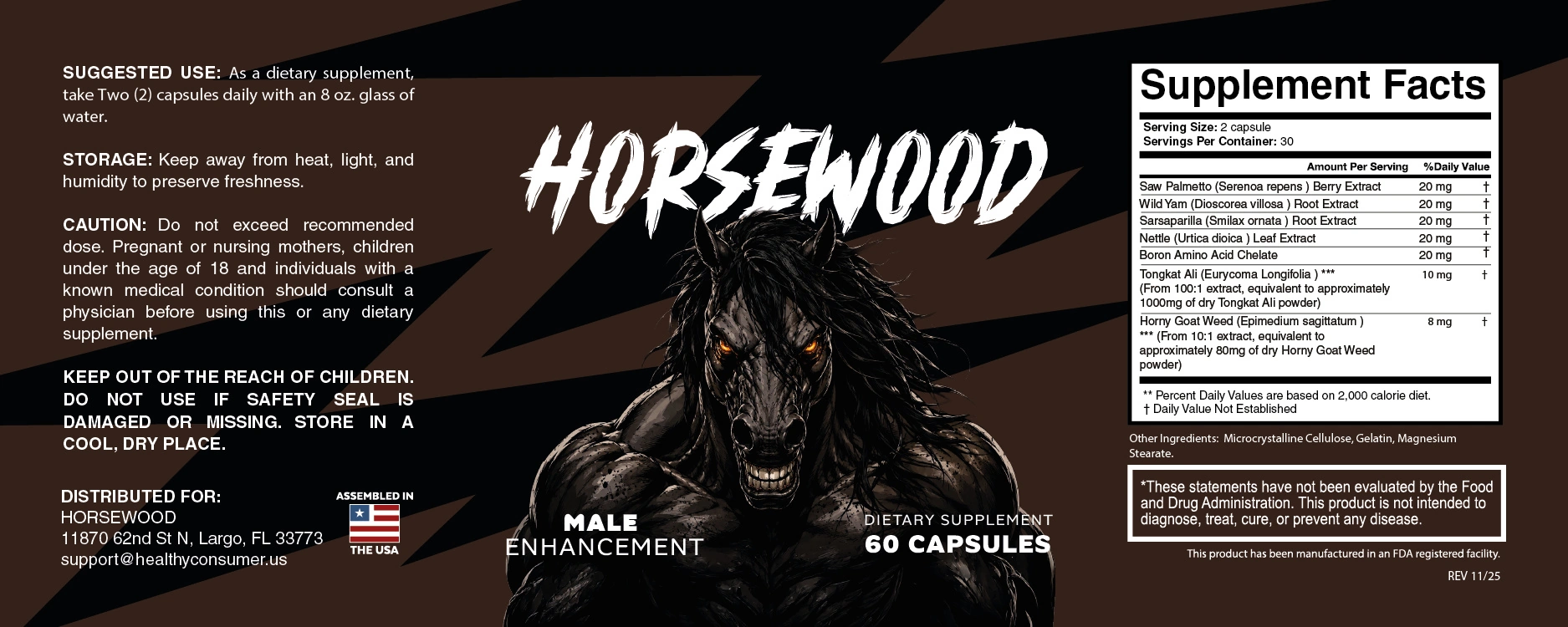
Two ingredients are listed with a ratio, and it changes how the numbers should be read. Tongkat ali appears at 10 mg as a 100:1 extract — the label states this is equivalent to approximately 1,000 mg of dry root powder. Horny goat weed appears at 8 mg as a 10:1 extract, equivalent to roughly 80 mg of dry powder.
This matters because a milligram of concentrated extract is not comparable to a milligram of ground herb. Any comparison between products that ignores the ratio is meaningless, and plenty of marketing depends on exactly that confusion.
A note on the other five. Saw palmetto, wild yam, sarsaparilla, nettle and boron are each listed at 20 mg without a stated ratio, so those should be read as 20 mg of extract rather than a dry-herb equivalent.
There is a structural trade-off in any broad formula and it is worth being explicit about it. A capsule holds a fixed volume. Every ingredient added takes a share, so a seven-ingredient product cannot deliver a research-scale dose of all seven. That is arithmetic rather than criticism, and it applies to every combination supplement on the market.
What you gain is breadth: several complementary areas covered in one daily habit, which is convenient and generally cheaper than buying six standalone products. What you give up is depth in any single one.
So if your interest is a specific compound at a specific dose — a clinical amount of saw palmetto, say — a standalone product will serve you better and usually cost less. If you want general daily support alongside an existing routine, a blend is a reasonable format. Choose accordingly, and choose with the real numbers in front of you.
Horsewood is a daily men's wellness formula built around seven labelled ingredients, taken as two capsules a day. Every package is covered by the 60-day money-back guarantee, and pricing and stock are confirmed on the official checkout.
From $49 per bottle on six · 60-day guarantee · Free US shipping on the six-bottle package